In distributed software engineering, simplicity is the ultimate prerequisite for reliability. Complex architectures with sprawling microservice graphs often fail not from technical limitations, but from runaway operational complexity.
Core Architectural Pillars
When building systems at Azathoth LLC, we anchor every design decision on three fundamental pillars:
- Minimalist Footprint: Eliminate unnecessary abstractions and middle layers.
- Predictable Latency: Enforce bounded execution times and strict timeouts across network boundaries.
- Self-Healing Topologies: Ensure nodes can crash and restart safely without cascading degradation.
Step-by-Step Optimization Process
To systematically eliminate bottlenecks, follow this staged sequence:
- Measure baseline latency percentiles ($p50$, $p99$, $p99.9$).
- Identify hot execution paths and unnecessary memory allocations.
- Replace chatty RPC round-trips with pipelined or batched requests.
- Validate under synthetic load before pushing to production.
System Architecture
The diagram below illustrates the end-to-end request flow through our edge routing and worker clusters:
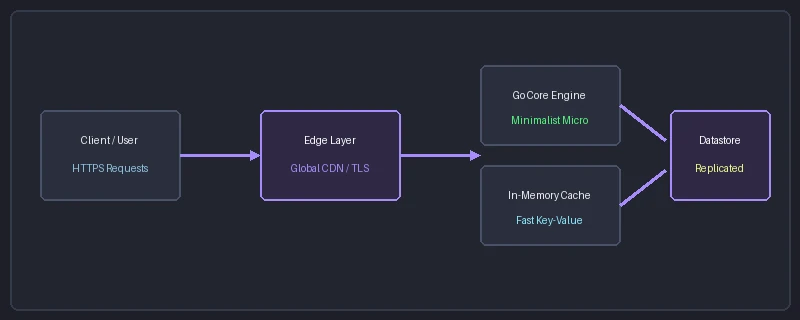
End-to-end request flow through edge routing, microservices, and storage.
Efficient Worker Implementation
Below is a production-ready example in Go demonstrating a bounded worker pool that handles concurrent jobs with graceful cancellation:
package main

import (
	"context"
	"fmt"
	"sync"
)

func worker(ctx context.Context, id int, jobs <-chan string, wg *sync.WaitGroup) {
	defer wg.Done()
	for {
		select {
		case <-ctx.Done():
			return
		case job, ok := <-jobs:
			if !ok {
				return
			}
			fmt.Printf("worker %d processed job: %s\n", id, job)
		}
	}
}
References & Further Reading
For more details on our design philosophy, visit our About page or read about the Bear Blog movement.