The web development landscape has spent a decade chasing JavaScript-heavy server-side rendering and client-side hydration. Yet for content delivery, nothing matches the speed, security, and low operational overhead of static site generators.
The Case for Zero-Dependency Toolchains
Modern front-end tooling often introduces thousands of dependencies in node_modules, creating fragile build pipelines and persistent security scan alerts. Hugo avoids this entirely:
- Single Binary: No runtime dependencies, no package managers, and no compilation step for the toolchain itself.
- Millisecond Build Times: Even sites with thousands of markdown files compile in fractions of a second.
- Rock-Solid Reproducibility: Builds produce deterministic static assets that can be served anywhere.
Build and Deployment Lifecycle
Static publication follows an unambiguous four-step lifecycle:
- Author content in clean Markdown with structured YAML/TOML frontmatter.
- Compile templates, assets, and feeds with the
hugocommand. - Verify output integrity and links.
- Push static artifacts to global CDN edge nodes.
Pipeline Architecture
The pipeline from raw markdown to global distribution is clean and direct:
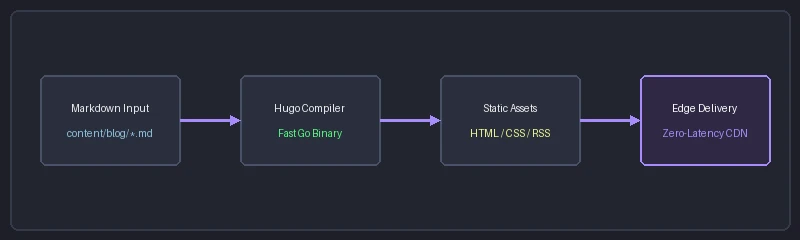
From raw Markdown to edge CDN delivery in milliseconds.
Configuration as Code
Hugo sites configure cleanly via standard TOML. Here is a sample module and build configuration:
baseURL = "https://azathothllc.com/"
title = "Azathoth LLC"
defaultContentLanguage = "en"
theme = "hugo-bearcub"

[markup.highlight]
  noClasses = false
  lineNos = false
Related Content
Learn more about our infrastructure principles in Building Fast and Resilient Systems, or check out the official Hugo Documentation.